Discuss Bone Composition, Functions, Classification based on Morphology
Description & Overview
1. Before You Start
Before studying the composition, functions, and classification of bones, make sure you understand these basic concepts:
- The human skeleton provides support and protection to the body.
- Bone is a specialized supporting connective tissue.
- Bones contain living cells and a hard extracellular matrix.
- The skeleton is divided into the axial skeleton and appendicular skeleton.
- Bones are connected to one another at joints and work with muscles to produce movement.
2. Topic Overview
Bone is a specialized, hard, and living connective tissue that forms the major structural framework of the human body. It consists of bone cells embedded in a mineralized extracellular matrix containing organic and inorganic components.
The organic component, mainly collagen, provides flexibility and tensile strength, while the inorganic component, mainly calcium phosphate in the form of hydroxyapatite, provides hardness and resistance to compression.
Bones support the body, protect internal organs, provide attachment for muscles, store minerals, and contain bone marrow involved in blood cell formation. Based on morphology, bones are classified into long, short, flat, irregular, sesamoid, and pneumatic bones. Some classifications also include sutural bones as an additional type.
3. Understand the Topic
Want a simpler Hindi-English explanation? Read this topic in Hinglish.
A. Composition of Bone
Bone is a living connective tissue made up of two main components: bone cells and extracellular matrix.
Bone cells are responsible for forming, maintaining, and breaking down bone tissue. The extracellular matrix is the material surrounding the cells and makes up most of the bone tissue.
The extracellular matrix contains three main components:
- Organic components, mainly collagen and other proteins.
- Inorganic components, mainly mineral salts such as hydroxyapatite.
- Water.
The organic and inorganic components of the extracellular matrix work together to give bone its strength, hardness, and toughness.
1. Organic Component
The organic component forms approximately 20–40% of the total weight of bone, depending on how the composition is measured. It is commonly described as forming about one-third of the dry weight of bone.
It mainly contains:
- Type I collagen fibres.
- Ground substance containing proteoglycans and glycoproteins.
- Non-collagenous proteins, such as osteocalcin, osteonectin, and osteopontin.
Functions:
- Provides flexibility and toughness to bone.
- Gives bone tensile strength, helping it resist pulling forces.
- Provides a framework for mineral deposition.
- Supports bone formation and mineralization.
2. Inorganic Component
The inorganic component forms approximately 50–70% of the total weight of bone. In mature bone, it generally forms about 60–70% of the dry weight.
It mainly contains mineral salts, especially calcium phosphate in the form of hydroxyapatite crystals.Other minerals, such as calcium carbonate, magnesium, sodium, and potassium, are also present in smaller amounts.
Functions:
- Provides hardness and rigidity to bone.
- Gives bone strength and helps it resist compressive forces.
- Acts as a mineral reservoir, particularly for calcium and phosphate.
3. Water
Water is an important component of bone tissue.It is present within the bone matrix and in spaces within the bone tissue.
Functions:
- Contributes to the physical properties of bone.
- Helps maintain bone toughness and flexibility.
- Supports the movement of substances within bone tissue.
Note: The percentages of organic material, minerals, and water vary depending on the type of bone, age, and method of measurement. The organic and inorganic percentages commonly quoted in textbooks refer to dry bone weight.
| Component | Main Constituents | Main Functions |
|---|---|---|
| Organic | Type I collagen, proteoglycans, glycoproteins and other proteins | Provides flexibility, toughness and tensile strength |
| Inorganic | Mainly hydroxyapatite (calcium phosphate) and other mineral salts | Provides hardness, rigidity and resistance to compression |
| Water | Water within the matrix and bone tissue | Contributes to bone toughness and physical properties |
B. Cells of Bone
Bone contains four main types of cells: osteoprogenitor cells, osteoblasts, osteocytes, and osteoclasts. Bone-lining cells are also present on bone surfaces.
1. Osteoprogenitor Cells
Osteoprogenitor cells are precursor cells that can develop into osteoblasts. They are derived from mesenchymal stem cells.
Functions:
- Multiply to produce more precursor cells.
- Differentiate into osteoblasts when needed.
- Help provide cells for bone growth, formation, and repair.
2. Osteoblasts
Osteoblasts are bone-forming cells that develop from osteoprogenitor cells.
Functions:
- Produce the organic bone matrix, called osteoid.
- Help in the mineralization of the bone matrix.
- Participate in bone growth and repair.
- Help form new bone during bone remodelling.
3. Osteocytes
Osteocytes are mature bone cells that develop from osteoblasts when they become enclosed within the bone matrix they have produced. They are located in small spaces called lacunae.
Functions:
- Help maintain the bone matrix.
- Sense mechanical loading and changes in forces acting on bone.
- Help regulate bone remodelling by communicating with other bone cells.
4. Osteoclasts
Osteoclasts are large cells responsible for bone resorption, which is the process of breaking down bone tissue. They develop from cells of the blood-forming lineage, not from osteoblasts.
Functions:
- Break down the mineral and organic components of bone.
- Help release stored minerals, particularly calcium and phosphate, from bone.
- Participate in bone remodelling by removing old or damaged bone tissue.
5. Bone-Lining Cells
Bone-lining cells are thin, flat cells derived from osteoblasts. They cover bone surfaces where active bone formation or resorption is not taking place.
Functions:
- Cover bone surfaces where active remodelling is not occurring.
- Help regulate the movement of minerals between bone and surrounding fluid.
- Participate in the regulation of bone remodelling.
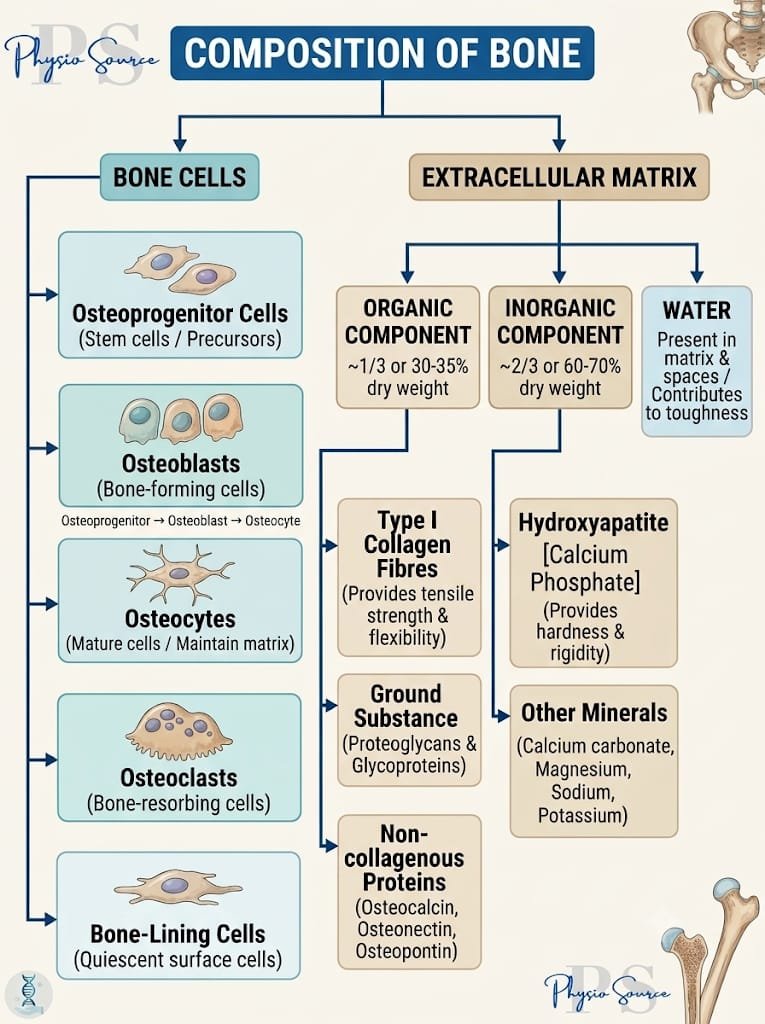
Developmental sequence to remember:
Osteoprogenitor cell → Osteoblast → Osteocyte
This represents the main pathway of bone-forming cell development. Osteoclasts...
✨ Reading in Preview Mode (50%)
Join PhysioSource to unlock full detailed descriptions, diagrams, and clinical insights.
Login to ContinueLearning Materials
Model Question Bank - Composition, Functions and Types of Bones
ACADEMIC REFERENCES AND FURTHER READING
Bottom Line
KEY TAKEAWAY
Bone is a living connective tissue composed of cells, organic matrix, inorganic mineral salts, and water. Its organic component provides flexibility and tensile strength, while its inorganic component provides hardness and resistance to compression. Bones support and protect the body, enable movement, store minerals, produce blood cells, and store fat. Based on morphology, bones are classified as long, short, flat, irregular, sesamoid, pneumatic, and sutural bones.
QUICK REVISION POINTS
- Organic component: mainly type I collagen; provides flexibility and tensile strength.
- Inorganic component: mainly hydroxyapatite; provides hardness and resistance to compression.
- Osteoblasts: bone-forming cells.
- Osteocytes: mature cells that maintain bone and sense mechanical loading.
- Osteoclasts: bone-resorbing cells.
- Functions: support, protection, movement, mineral storage, blood cell formation, fat storage, and endocrine activity.
- Long bones: femur, humerus.
- Short bones: carpals, most tarsals.
- Flat bones: ribs, sternum, scapula.
- Irregular bones: vertebrae, hip bone.
- Sesamoid bones: patella, pisiform.
- Pneumatic bones: frontal, ethmoid, sphenoid, maxilla.
- Sutural bones: accessory bones within skull sutures.
EXAM PERSPECTIVE
For a short-answer question, define bone and briefly describe its composition, major functions, and morphological classification with examples.
For a long-answer question, explain the organic and inorganic components, describe the major bone cells, list the functions of bones, and classify bones based on morphology with features and examples. A labelled diagram or comparison table can help present the classification clearly.
CLINICAL INSIGHT
Bone morphology influences how bones support body weight, protect organs, and act as levers during movement. The composition of bone also determines its mechanical properties. These concepts help physiotherapists understand fractures, bone loading, muscle function, and rehabilitation after injury.